

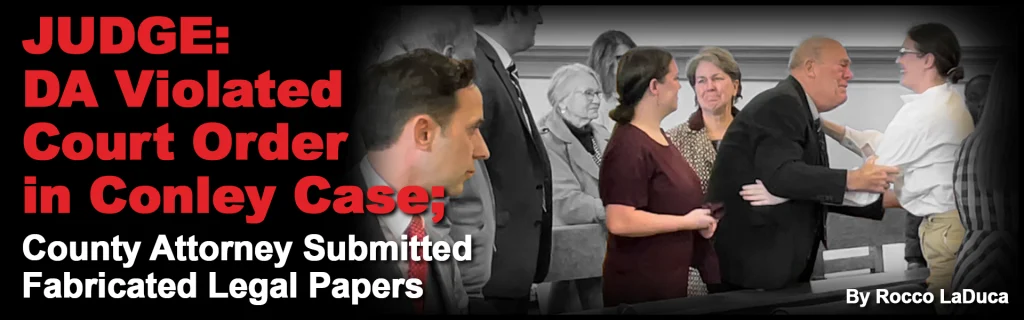
JUDGE: DA Violated Court Order in Conley Case;
County Attorney Submitted Fabricated Legal Papers
Prosecutor Accuses Judge of Bias for Acquittal
By ROCCO LaDUCA / Talk of the Town 100.7 FM
Email: RoccoL@rosergroup.com
July 24, 2025
(Updated July 25, with Melissa Swartz response to Judge Recusal Motion)
UTICA – When Kaitlyn Conley’s guilty verdict was vacated earlier this year in the death of her boss Dr. Mary Yoder, a State Supreme Court justice ordered that all records in Conley’s criminal case be sealed from the public as she was released from prison.
While the Mohawk Valley and beyond anxiously wonder whether Conley would be charged again, a lot has happened since then – all shrouded under a cloak of secret court proceedings, until recently-released court records and transcripts show exactly what has been going on:
COURT ORDER VIOLATED: On June 10, the judge who released Conley – Justice Bernadette T. Clark – ruled that prosecutors with the Oneida County District Attorney’s Office violated her Feb. 4 Sealing Order by using some of the off-limit records to pursue new charges against Conley.
EXAGGERATED INVESTIGATION: After already presenting those sealed records to a Grand Jury this Spring, prosecutors then belatedly tried to fix their mistake by having the Oneida County Sheriff’s Office disingenuously ask Justice Clark on May 28 to unseal Conley’s records so they could continue an “ongoing investigation” into Yoder’s 2015 poisoning death, nearly 10 years after the probe had already ended, according to court documents.
COUNTY ATTORNEY RESIGNS: The Oneida County Attorney – Amanda Cortese-Kolasz, at the time – who was tasked with providing the legal basis for the Sheriff Office’s request to unseal Conley’s records, resigned from her position on July 15, just weeks after Judge Clark found she had fabricated court cases and misquoted other cases in the documents she submitted to the Court on the Sheriff’s behalf, records show.
ALLEGING JUDGE BIAS: And now, Oneida County District Attorney Todd Carville is accusing Justice Clark of doing everything she can to prevent Conley from ever being charged, based partially upon offhand remarks Clark reportedly made during a holiday dinner last year stating she believed Conley was innocent, and that Yoder was killed by her husband. Carville has since filed a motion for Justice Clark to recuse herself from the case, which will be debated in State Supreme Court on Aug. 7, in Utica.
In other words: Everything is one big mess, and it remains to be seen if, and when, Conley will ever be arrested again.
Carville declined to comment for this story, and Conley’s attorney Melissa Swartz did not respond to multiple attempts to speak with her. But the court records speak for themselves, which were obtained through the Oneida County Clerk’s Office and the County Supreme Court Clerk.
During a court proceeding on June 10 to debate whether Conley’s records should be unsealed, Carville told Justice Clark that his office did nothing wrong in trying to use records that he believes should never have been sealed in the first place, according to transcripts of the proceeding.
Justice Clark disagreed, and said Carville should have objected – either verbally or in writing – in early February when Clark announced that she would be sealing the records at the request of Conley’s attorney.
“None of those things happened, though, so it was not the Court’s job to protect the district attorney’s office from the consequences of its own decisions and lack of objections,” Clark told Carville.
Clark then denied the request to unseal Conley’s records and directed the District Attorney’s Office to “immediately cease and desist” from using any more of the sealed records to potentially prosecute Conley once again.
It is unclear how Justice Clark’s rulings will now impact any future prosecution of Conley, or if the Grand Jury that was considering Yoder’s death will have to be scrapped because of any sealed records it might have seen.
“The Court has not determined at this stage what the appropriate remedy for this Sealing Order violation is,” Justice Clark stated June 10. “Nevertheless, the Court feels compelled to point out that a violation has occurred.”
June 12 – Judge Finding DA Violated Sealing Order
SECRET COURT PROCEEDINGS
Yet, the public was in the dark this whole time.
While these proceedings were going on in June, Justice Clark ordered everything that happened in Court remain confidential for the time being due to the sensitive nature of the sealed materials and Grand Jury matters being discussed. And, Clark noted, to allow all sides to “digest the Court’s ruling and determine their next steps, without undue pressure or scrutiny from the media.”
But on June 30, Clark lifted that “gag order” – over the objection of prosecutors – after Conley’s attorney expressed no concern that any publicity would be detrimental to a fair trial. Justice Clark also determined which court papers and transcripts would be released, with necessary redactions.
Conley, 23 years old at the time, was initially charged with second-degree murder in 2016 for Yoder’s poisoning death by colchicine. After a jury in Conley’s first trial could not reach a unanimous verdict, a second trial in 2017 ended with Conley being acquitted of murder but found guilty of the lesser charge first-degree manslaughter.
Conley was sentenced to 23 years in prison, where she was serving time until Jan. 31 this year, when the Appellate Division, Fourth Department, vacated her conviction by finding that she had been denied effective assistance of counsel. Conley’s prior attorneys, the appellate court ruled, had seriously prejudiced Conley’s trials by failing to seek the suppression of evidence from her cell phone.
DINNER DEBATE AT TURNING STONE
While Justice Clark is currently preventing the District Attorney’s Office from using any sealed materials to further prosecute Conley, Carville believes this is only happening because Clark is on Conley’s side.
When Carville and Conley’s attorney Swartz return to State Supreme Court at 11 am on Aug. 7 to debate Carville’s recusal motion, Carville will be asking Justice Clark to recuse herself from this case based upon his belief that she is biased in Conley’s favor, according to his motion papers.
Carville hopes to have Justice Clark replaced by a new justice, one whom Carville believes would more likely consider unsealing Conley’s records so they could be used to bring Yoder’s killer to justice.
“There has been a continued failure to remedy a ruling which speaks directly to this Court’s desire to control the outcome of this criminal case,” Carville wrote in his June 25 motion to recuse Clark.
“It is clear, based on the orders and decisions by Judge Clark during the timeframe in which she has been assigned to the case, that same were made to further an objective of acquitting Kaitlyn Conley, an individual whose innocence Judge Clark heatedly argued for on Dec. 11, 2024,” Carville’s motion added.
Clark’s comments on Dec. 11 concerning Conley’s innocence were made weeks before Conley’s conviction would be vacated Jan. 31, and well before she would be assigned to preside over Conley’s release in February. Another judge, now-retired Oneida County Court Judge Michael L. Dwyer, had presided over all of Conley’s past trials and proceedings.
Nevertheless, Carville sees proof of Justice Clark’s bias toward Conley, and he submitted signed statements from two people who witnessed Clark’s alleged remarks at the Oneida Nation Holiday Party at the Turning Stone Casino. According to Carville’s motion papers, Clark’s comments were made on Dec. 11 in the presence of several high-profile figures sitting at the table, including Oneida County Executive Anthony Picente, former Assemblywoman Roann Destito, former Oneida County District Attorney Scott McNamara and Picente’s Chief of Staff Kevin Revere, as well as Carville.
When the topic of Conley’s case was brought up by someone at the dinner table, it triggered a heated back-and-forth between Clark and Revere, according to Revere’s statement, signed June 13.
“I expressed my opinion of her guilt and Judge Clark expressed her opinion of her innocence,” Revere recalled in his statement. “Judge Clark stated that she believed the husband did it. I remember saying to her ‘Are you out of your f****** mind? Her DNA was on the bottle of poison!’ Judge Clark responded stating that they explained all that and the husband did it because he was having an affair with the sister. I replied that no, the DNA wasn’t explained away but from what I remembered the allegation of an affair was explained and found not to have happened.”
Retired District Attorney Scott McNamara also provided his account of the conversation in a written statement, included in Carville’s motion papers.
“I was somewhat surprised that Judge Clark was making these comments in front of me as I was the District Attorney when Conley was convicted,” according to McNamara’s statement, dated June 20. “Judge Clark discussed her views with Kevin (Revere) and continuously stated that the victim, Mary Yoder’s husband, was having an affair with one of Mary’s sisters. In my opinion, based upon the evidence known to me and much of it being presented at the trials, Bill Yoder did not have an affair with Mary’s sister. The evidence was clear that he started dating Mary’s sister sometime after Mary died.”
McNamara added, “I have a vivid memory of what Judge Clark was saying because I did not agree with her or her version of the facts she was expounding.”
Such a heated dinner debate over facts of a high-profile homicide case rarely finds itself spilling over into courtroom proceedings, but this spirited Turning Stone discussion is somewhat symbolic of the sharply divided opinions the Conley case enflames among the public.
DEFENSE OPPOSES JUDGE RECUSAL (UPDATED July 25)
Conley’s attorney has since filed on July 24 her legal response to Carville’s motion to recuse Justice Clark. In her papers, Swartz argues that Carville’s reliance on the Dec. 11 conversation – before Conley’s matter was reversed – “changes nothing.”
“In a last-ditch effort to deflect from their own easily preventable failures, the People now ask this Court to recuse itself,” Swartz writes in her motion. “This motion bears all the hallmarks of their prior missteps: procedural confusion, misstatements of law, and logically incoherent arguments. Rather than accept responsibility, the People continue their fixation on blame-shifting – energy that would have been better spent understanding the legal issues they continue to mishandle.”
Swartz noted that the judge’s rulings on Feb. 4 and June 10 that Carville now says were biased were not discretionary in nature and therefore couldn’t possibly be prejudiced by favoritism, since they were based on legal requirements.
Particularly, Swartz questions when and how Carville first heard of the alleged comments by Clark on Dec. 11 concerning Conley’s innocence.
Carville states he first became aware of the alleged conversation on June 11, Swartz writes, “Yet tellingly, the motion is devoid of any factual details explaining how this information came to light – an omission that appears calculated to obscure whether DA Carville himself, or someone else within his Office, violated this Court’s gag order or had prior knowledge of this supposed conversation before June 11.”
Swartz also took issue with the timing of Carville’s allegation now, only after Justice Clark had decided against the District Attorney’s Office.
“This clear gamesmanship is improper and squarely at odds with well-settled law that a party who ‘inexplicably’ sits on a purported allegation of bias until after receiving an unfavorable ruling forfeits that claim,” Swartz wrote.
Finally, Swartz noted that expressing an opinion does not immediately disqualify a judge from remaining fair and impartial.
“Judges, by the very nature of their role, routinely form preliminary impressions after reviewing grand jury minutes or presiding over trials,” Swartz wrote. “Those impressions are human and inevitable – but they do not amount to bias, nor do they impair a judge’s ability to set aside personal views and rule according to the law and the facts.”
June 25 – DA Motion To Recuse Judge
TRYING TO UNSEAL RECORDS
This latest chapter began unfolding in late Spring, after DA Carville announced April 17 that his office would once again present evidence to a Grand Jury “to determine what, if any, charges would be appropriate” in Yoder’s death.
Since that announcement, both Carville and Conley’s attorney Swartz have discussed the “potential resolution of this matter,” while also reserving Conley’s right to testify to the Grand Jury, according to Swartz’s court documents.
During those discussions, on May 23, Swartz asked Carville if anyone filed an application to unseal Conley’s records, which Justice Clark had sealed without objection on Feb. 4. Swartz told Carville she “believed the failure to unseal the file was an issue,” her motion states.
A potential arraignment date for Conley had been scheduled for May 30 or June 2, Swartz noted. But instead, Carville informed Swartz on May 28 that the Sheriff’s Office had just applied to unseal Conley’s file – weeks after “a significant amount of testimony and evidence, if not all the evidence” had already been presented to the Grand Jury.
When Oneida County sheriff’s Lt. Richard Paul, Jr. filed an application with Justice Clark on May 28 requesting access to all sealed records, he stated the reason was “to continue its extensive investigation into the death of Mary Yoder” and “to conclude its investigation and ultimately bring the responsible party to justice,” according to his filing.
But Swartz wasn’t buying it. She immediately sent an email to Justice Clark the next day, May 29, asking the judge to deny the Sheriff’s Office request.
“Law enforcement has not investigated this case in nearly a decade,” Swartz wrote in her email to Justice Clark. “Instead, only the District Attorney is seeking these records to further a grand jury presentation that is apparently already, or nearly, completed. In short, this is not a legitimate investigative need by law enforcement, but a prosecutorial strategy to use the Sheriff as a proxy and circumvent the proper sealing of Ms. Conley’s file.”
Swartz added, “If the District Attorney’s Office wished to preserve access to these sealed records, it is incumbent upon them to seek a stay or raise an objection before this Court’s sealing order was executed. They did not.”
When sheriff’s Lt. Paul was later questioned by Justice Clark during the confidential hearing on June 10, he explained that the closed investigation into Yoder’s death became “ongoing” once again only after the DA’s Office convened a new Grand Jury in the spring.
“Well, it is an active investigation in the sense that we would still like to present it to the Grand Jury, and obviously, if we got any other information, then we would follow up on that,” Paul testified.
Then when DA Carville was given the opportunity to question Paul during this proceeding, Paul acknowledged that he only filed an application to unseal the records after the prosecutor, Assistant District Attorney Nicholas Fletcher, alerted him to the possibility of evidence being sealed.
“Was that to correct any potential error that may have transpired without your knowledge?” Carville asked Paul during the hearing, referring to evidence that might already have been presented to the Grand Jury.
“That’s correct,” Paul replied.
But when questioned by Swartz, Conley’s attorney, Paul also admitted that no member of the Sheriff’s Office was currently assigned to investigate Conley’s case, despite his unsealing application stating there was an “ongoing investigation.”
Then-County Attorney Cortese-Kolasz explained that the Sheriff’s Office needed to unseal the evidence so Yoder’s death could be further investigated by the Grand Jury, but Justice Clark pointed out that request was actually initiated by the District Attorney’s Office.
Judge Clark’s point: That if the District Attorney’s Office needed access to the sealed records for the Grand Jury, then prosecutors should have made the unsealing request, not the Sheriff’s Office.
‘IGNORANCE OF THE LAW IS NO EXCUSE’
District Attorney Carville, however, argued that it made no sense that evidence in Conley’s case would be sealed after her conviction was vacated, since the Appellate Division explicitly stated they could pursue new charges again, with no indication the records should be sealed.
“It is counterintuitive to believe that we were given the opportunity to re-present the case to the Grand Jury, and yet, couldn’t use any evidence to do so,” Carville told Justice Clark.
Then Carville should have objected when Justice Clark stated she was going to seal the records at the request of Conley’s attorney Swartz, Clark admonished.
“It is not this Court’s job to raise objections on behalf of the district attorney that the district attorney himself failed to contemplate,” Justice Clark said, according to transcripts. “What the Court had before it was a request by the defense for sealing and a lack of objection from the district attorney to that sealing request.”
As Justice Clark denied the request to unseal Conley’s records, she stated, “Just as ignorance of the law is no excuse for a criminal defendant, it is no excuse for the district attorney’s office.”
DA CARVILLE ‘FALLS ON SWORD’
Once Conley’s attorney made prosecutors aware that she believed they “were doing something wrong” with sealed records, Carville said they immediately stopped the Grand Jury presentation until this issue was resolved.
Now, Carville was asking Justice Clark to “correct an error” when he failed to perceive that her Sealing Order would apply to any underlying evidence in Conley’s case.
“I know I didn’t object, and I apologize, and I fall on the sword for that, your Honor,” Carville told Justice Clark, according to transcripts.
“We just want justice to prevail, and the interests of justice in this case is that the evidence that this case has (should) be unsealed for the Grand Jury to consider it and let them make a decision,” Carville added.
Carville also suggested that it was the strategy all along of Conley’s attorney to create this legal mess for prosecutors.
“I don’t want to make allegations, your Honor, but this was a shrewd move by defense counsel, in the attempt to get us in the place that we are now,” Carville said. “In no world is it appropriate for us to have the ability to re-present to a Grand Jury but not be able to use the evidence to do that.”
May 28 – Sheriff Request To Unseal Conley Records
CONLEY’S ‘SHREWD’ ATTORNEY REPLIES
In response to Carville’s criticisms, Conley’s attorney defended her arguments by explaining that “the integrity of our justice system demands that rules apply to everyone, even when it’s inconvenient – especially when it’s inconvenient.”
“My actions in this case have been referred to as shrewd,” Swartz explained in court, according to transcripts. “If knowing the law, applying the law, and protecting my defendant and protecting my clients is shrewd, then here I am, Judge, standing before you; I’m shrewd.”
Despite whatever Carville believes should have happened in this case, Conley’s attorney Swartz insists the law automatically triggers the sealing of a defendant’s record once their conviction is vacated, unless there’s a timely objection. And when prosecutors don’t follow the rules, Swartz said, then there should be consequences, just like there would be for defense attorneys.
When Judge Clark prepared to seal Conley’s records on Feb. 4, Swartz noted, “No one said: Hold up. Please don’t seal. The interest of justice.”
“He doesn’t get to circumvent the statute because he failed to do what was in plain writing for him to do,” Swartz said of Carville. “He doesn’t get to do that. And that’s exactly what this is. This is a way to circumvent what he failed to do and then cast aspersions on everybody else in this room, as if we’re not the ones following the rules.”
When Justice Clark spoke from the bench that day, it was clear she also believed that the District Attorney’s Office, the Sheriff’s Office and the County Attorney weren’t following the rules, according to transcripts. Instead, the judge suggested, it would appear they were trying to pull a fast one over the Court.
“The timing of the application strongly indicates that the Sheriff’s Office only brought the application because it was at that point that the DA’s office realized they had a problem with the use of potentially sealed evidence before the Grand Jury,” Justice Clark stated.
“This Court believes that a prosecutor’s office cannot get around this clear limitation by misstating that an application brought at its behest is, instead, being sought by a local police agency,” Clark added.
There was no ongoing investigation, Clark stated, “But rather, the Sheriff and District Attorney continue to believe what they have argued all along, that Miss Conley, alone, killed Mary Yoder.”
May 29 – Conley Motion to Deny Unseal
FABRICATED COURT PAPERS CAUGHT
The crux of this legal matter surrounds the question of whether the District Attorney’s Office did anything wrong in using Conley’s purportedly sealed records, and what price prosecutors should have to pay.
But perhaps the most bizarre moment of this entire drama that highlights the consequences of one’s actions is when it was discovered that then-Oneida County Attorney Amanda Cortese-Kolasz appeared to have included a number of phony court cases and misquoted citations in the legal papers she submitted to the Court, the documents show.
After Cortese-Kolasz had submitted a Memorandum of Law on May 28 to provide the legal basis for the Sheriff’s Office to request Conley’s records be unsealed, Conley’s attorney Swartz said she was unable to locate any information about the case Cortese-Kolasz identified: “Matter of New York City Police Department v District Attorney of Kings County.”
Then, after Swartz received Cortese-Kolasz’s Supplemental Memorandum on June 5, she discovered even more problems with the County Attorney’s cited cases. That’s when Swartz felt the urgency to alert Justice Clark, documents show.
“I wanted to bring it to the Court’s attention because it places us in an untenable position for oral argument: arguing against propositions that are simply not based in law,” Swartz wrote in a June 5 email to Justice Clark. “It is unreasonable to expect me – or any party – to respond to legal positions that are not grounded in verifiable case law.”
The following day, on June 6, Justice Clark reviewed all of the questioned citations provided by Cortese-Kolasz and identified at least 15 instances of errors, documents show, including six court cases cited that do not exist; two laws and three court cases that were misquoted; as well as two laws and two court cases that do not represent the principles for which they were cited.
No possible explanations were provided in the available records to explain this “serious misconduct,” as Clark described it, according to transcripts. In Justice Clark’s next action through a Court Order on June 6, however, it was clear she did not have faith in anything else the County Attorney would provide on behalf of the Sheriff’s Office.
Justice Clark cited the Rules of Professional Conduct for attorneys that require a “lawyer shall not knowingly make false statements of fact or law to a (court) or fail to correct a false statement of material fact or law previously made to the (court) by the lawyer.” Justice Clark also noted other decisions in New York in which Courts have acted against attorneys who provide “fictional or erroneous” citations.
As a result, Justice Clark ordered that Cortese-Kolasz’s May 28 and June 5 legal memoranda be “stricken” from the record and “will not be considered by the Court.” The judge also prohibited Cortese-Kolasz from submitting any further papers in this matter to unseal Conley’s records.
COUNTY ATTORNEY RESIGNS AFTER ‘PROFESSIONAL ERROR’
Cortese-Kolasz has since resigned July 15 as County Attorney – the day after the Talk of the Town initially contacted Oneida County Executive Anthony Picente’s office seeking comment about Justice Clark’s troubling findings.
When Picente’s staff was first contacted July 14, Talk of the Town was told Cortese-Kolasz was on “paid administrative leave,” but they would not comment any further on a personnel matter or pending legal matter.
Early the next morning, on July 15, Talk of the Town emailed Cortese-Kolasz directly seeking an explanation for her erroneous court filings in the Conley case.
Cortese-Kolasz never responded to that request. But by the next afternoon, Picente announced that Cortese-Kolasz had resigned as County Attorney on July 15 after making an unspecified “professional error,” which she took responsibility for, according to his news release.
It remains unclear whether that “error” was referring to her papers filed in the Conley matter, and Picente said Cortese-Kolasz would continue to serve the County “in a different capacity.”
On July 29, Picente’s office confirmed that Cortese-Kolasz was currently serving as Assistant County Attorney.
June 5 – Letter Questioning County Attorney Legal Papers
June 6 – Judge Order Striking County Attorney Legal Papers
Rocco LaDuca co-hosts the Talk of the Town radio show on TALK! 100.7 WUTQ-FM every weekday morning, from 6 to 10 am. He can be reached by email at: RoccoL@rosergroup.com