
SUNY Poly Professor Kazuko Behrens explains Parent & Child Attachment Research Study and Seeking Right-Handed Moms
January 27, 2026
Utica Police Chief Mark Williams clarifies Rumors of ICE Agents in City and UPD Policy for Immigration Enforcement
January 27, 2026Aircraft had difficulty seeing each other before deadly mid-air crash near DC: NTSB
Aircraft had difficulty seeing each other before deadly mid-air crash near DC: NTSB
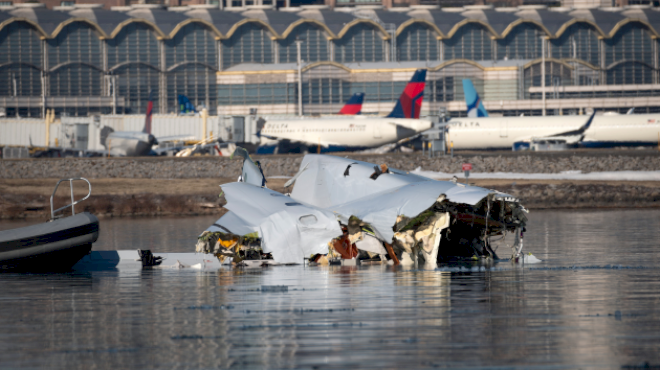
(WASHINGTON) — The National Transportation Safety Board on Tuesday presented a cockpit visual simulation demonstrating what contributed to the deadly mid-air collision between an Army helicopter and an American Airlines jet near Washington, D.C., last year.
The simulation indicates it was very difficult for both aircraft to see each other before the January 2025 crash that killed 67 people as the jet was landing at Ronald Reagan National Airport, according to the NTSB.
The first video shows the last three minutes before the collision from the viewpoint of the right seat of the helicopter.
Around 8:46:15, a magenta circle with a label “Flight 5342” appears just above the horizon on the right side of the upper portion of the screen. The label “Flight 5342” fades out about 8:46:35. The magenta circle tracks the lights of Flight 5342 and remains visible until the airplane becomes visually recognizable about a minute later.
After a Traffic Alert and Collision Avoidance System warning indicated in the transcript, the local controller on the ATC recording is heard asking the pilots if they have the CRJ (Flight 5342) in sight and the pilots confirm they do. It remains unclear what they thought they had in sight. There was only one controller working both the helicopter and plane traffic, the NTSB said.
The simulation screen goes black at the moment of the collision.
The second animation shows the viewpoint of pilots from Flight 5342 as the plane approaches the runway to land. According to the cockpit voice recorder transcript shared by the NTSB, the last words about one second before the crash from both the first officer and the captain were “oh” and “ohhh ohhhh” as the animation shows the helicopter colliding with the plane.
About 90% of wreckage from both aircraft was recovered by the NTSB.
A third animation shows what the local controller from the DCA tower saw at the time of the crash as they were handling the air traffic and issuing instructions. Based on the recordings, the NTSB said Flight 5342 was not warned by the controller of the nearby helicopter at any point. A conflict alert came 26 seconds before the collision between the two aircraft as they were 1.6 miles apart, according to the NTSB.
According to the NTSB, the local tower said they were concerned about the close proximity of the helicopter and Flight 5342.
“This coupled with the conflict alert that was active at the time, the controller should have issued a safety alert, which would have included updated traffic advisory information and an alternate course of action if feasible, neither were done. In this case, had a safety alert been issued, it would have increased the situation awareness of both crews and alerted them of their closing proximity to one another. Additionally, a timely safety alert may have allowed action to be taken by one or both crews to avoid avert the collision,” NTSB investigator Brian Soper said at the hearing.
Ahead of Tuesday’s hearing, Chair Jennifer Homendy said she fears that some of the agency’s safety recommendations, which will be issued at the conclusion of the hearing, may once again go unimplemented.
“Of course I’m concerned. We have 300 aviation recommendations that still haven’t been implemented. Those recommendations were issued because somebody died or was injured, and they have not been implemented yet. So here we are again,” Homendy told ABC News.
“So yes, at the end of this, I am concerned that we’re going to issue recommendations and that they won’t be implemented,” Homendy said. “I can tell you, and anyone who knows me knows I vigorously advocate for the implementation of our recommendations. I don’t care when it is. Could be 50 years later, as I did with positive train control, and I will not hold back on these.”
At Tuesday’s hearing, NTSB investigators will present their investigative findings to board members and the public. NTSB board members, including Homendy, will then question investigators and the parties to the investigation.
At the end of the hearing, the board members will vote on the probable cause of the crash and the agency’s safety recommendations. The NTSB can only make recommendations and does not have the authority to enforce them, therefore they are not always adopted.
Though a formal final report will be released two weeks after the hearing, this hearing will mark the end of what Homendy described as “one of the most complex investigations” conducted by the agency, which they had aimed to conclude by the first anniversary of the mid-air collision.
Homendy told ABC News the investigation “was not easy and it was definitely not straightforward.”
“We will start in one direction and then take it in a different direction, depending on what we’re finding, and then we’ll exclude things that didn’t have anything to do with the investigation. But we have to do our due diligence to make sure that we’re tracking all of that down, all that evidence to support that it wasn’t a factor, while also looking at the issues that were,” Homendy said.
Homendy said the helicopter altimeter discrepancy is what surprised her the most in this investigation.
“The altimeters I did not see coming, that we would have some problems with how the altimeters were reading,” Homendy said.
During last year’s three-day investigative hearing, investigators said they found discrepancies in the altitude data shown on radio and barometric altimeters on Army helicopters after conducting test flights following January’s accident.
It is likely that the helicopter crew did not know their true altitude due to notoriously faulty altimeters inside this series of Black Hawks, according to the investigation. At their closest points, helicopters and planes flew within 75 feet of each other near DCA, an astonishingly close number. During the hearings, the NTSB was told Army Black Hawks can often have wrong readings and a margin of error of +-200 feet.
Another key focus of Tuesday’s hearing is the close proximity of the helicopter route to the runways at Reagan National Airport. According to the NTSB, which cited FAA surveillance data, there were over 15,000 close-proximity events between helicopters and commercial aircraft at DCA between October 2021 and December 2024.
Homendy said warnings about the close proximity were raised by people, but they were ignored.
“Years ago, that hot spot was identified and [people] repeatedly tried to say that the helicopter route needed to be moved, and nobody listened. It was like the ultimate in government bureaucracy,” Homendy said.
“They were completely ignored. Told it couldn’t be done, not responded to, said it would probably be too political. Those are quotes from our interviews, but they went nowhere.”
At last year’s hearing, FAA officials cited “bureaucratic process” as a deterrent to addressing these issues.
Other topics expected to be discussed include the approval of helicopter routes near DCA, the experience level of the air traffic controllers working in the tower at the time of the crash, the visibility study, and the testing of the barometric altimeters.
When asked what stays with her from this investigation, Homendy pointed to a personal item recovered with the wreckage.
“In the hangar, we had the Black Hawk laid out. We had the wreckage laid out for 5342 and on the side next to 5342 there were some personal effects, and a lot of people mentioned different things, but every time I passed, there was a brown teddy bear, just eight inches maybe, and it was muddy and dried mud, dried water, and I just kept looking at the teddy bear, and that’s the thing that sticks with me,” Homendy said.
Copyright © 2026, ABC Audio. All rights reserved.