Protesters clash with law enforcement outside Texas facility where detained 5-year-old is held
January 29, 2026
Potential blizzard headed to Southeast this weekend: Latest forecast
January 29, 2026Iranian ‘fingers on triggers’ amid US military buildup, Trump threats, Tehran says
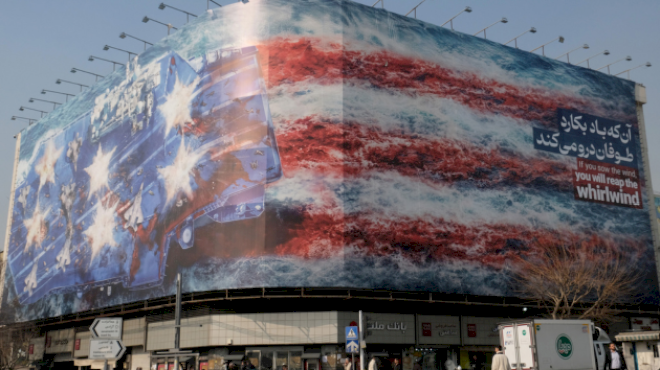
Iranian ‘fingers on triggers’ amid US military buildup, Trump threats, Tehran says
(LONDON) — Iranian military forces are prepared to “immediately” retaliate against any U.S. attack, Tehran’s top diplomat warned on Wednesday, as more American military assets arrived in the region and U.S. President Donald Trump threatened to launch a new attack on the country.
Iranian Foreign Minister Seyed Abbas Araghchi said in a post to X on Wednesday that Iran’s “brave Armed Forces are prepared — with their fingers on the trigger — to immediately and powerfully respond to ANY aggression against our beloved land, air and sea.”
“Valuable lessons learned” during the 12-day conflict with Israel and the U.S. in June “have enabled us to respond even more strongly, rapidly and profoundly,” Araghchi wrote.
“At the same time, Iran has always welcomed a mutually beneficial, fair and equitable NUCLEAR DEAL — on equal footing, and free from coercion, threats, and intimidation — which ensures Iran’s rights to PEACEFUL nuclear technology, and guarantees NO NUCLEAR WEAPONS,” the foreign minister added.
“Such weapons have no place in our security calculations and we have NEVER sought to acquire them,” he wrote.
Araghchi issued the warning after Trump touted what he called a “massive armada” heading toward Iran, which he said was “ready, willing, and able to rapidly fulfill its mission, with speed and violence, if necessary.”
Trump urged Iran to make “a fair and equitable deal” regarding its nuclear program, key facilities and personnel of which were among the targets attacked by Israel and the U.S. in June.
“Hopefully Iran will quickly ‘Come to the Table’ and negotiate a fair and equitable deal — NO NUCLEAR WEAPONS — one that is good for all parties. Time is running out, it is truly of the essence!,” Trump said a social media post.
Trump referred to the strikes on Iran’s nuclear sites last summer. “As I told Iran once before, MAKE A DEAL! They didn’t, and there was ‘Operation Midnight Hammer,’ a major destruction of Iran. The next attack will be far worse! Don’t make that happen again,” Trump added.
The aircraft carrier USS Abraham Lincoln, accompanied by three destroyers, arrived in the Middle East earlier this week, bolstering the U.S. military presence in the region.
The carrier is carrying a complement of strike aircraft, while the accompanying destroyers are armed with Tomahawk missiles.
The naval buildup adds some 5,000 American troops to the region, swelling an already robust American military footprint spread across multiple bases across the Middle East, such as Al Udeid Air Base in Qatar.
In total, more than 30,000 U.S. troops are deployed across the Middle East. The USS Abraham Lincoln is the first U.S. aircraft carrier to operate in the region since last summer.
Araghchi on Wednesday denied any request for new talks Tehran and Washington, D.C., though said Iran was in touch with “various intermediaries.”
“Our position is clear. Negotiations cannot take place under threats, and any talks must be conducted in conditions where threats and excessive demands are set aside,” Araghchi said.
The speaker of the Iranian parliament, Mohammad Bagher Ghalibaf, said on Thursday that Iran is “ready for sincere and genuine negotiations with America,” as quoted by the state-aligned Tasnim News Agency. Ghalibaf warned that though Trump “may be able to start a war,” he cannot foresee how it will end.
Trump’s latest threats focused on Iran’s nuclear program, which — alongside Tehran’s ballistic missile arsenal and its use of regional proxy forces — has been a key and longstanding concern for the U.S., Israel and their regional partners.
Trump’s Wednesday social media post did not mention Tehran’s bloody suppression of nationwide anti-government protests over the past month. The demonstrations began in late December in response to the collapsing value of the national currency — the rial — before morphing into a wider anti-regime movement which drew backing from dissidents abroad and Western governments.
Trump lent his support to protesters in mid-January, urging them to “KEEP PROTESTING — TAKE OVER YOUR INSTITUTIONS!!!” He added, “HELP IS ON ITS WAY.”
The president then appeared to back off the prospect of imminent U.S. strikes on Iran, saying Tehran had informed him that the killing of protesters and executions of those arrested had stopped.
The major security crackdown appears to have suppressed the massed demonstrations. The U.S.-based Human Rights Activists News Agency (HRANA) — which relies on a network of activists in Iran for its reporting and has been accurate during previous unrest — said Wednesday that at least 6,373 people had been killed in the protests.
The dead included 5,993 protesters, 113 people under the age of 18, 214 government-affiliated personnel and 53 non-protesting civilians, HRANA said. The organization said it is still reviewing 17,091 reports of other deaths.
A total of 42,486 people have been arrested in the demonstrations since they began on Dec. 28, including 11,018 injured protesters with serious wounds, according to HRANA.
ABC News cannot independently verify HRANA’s numbers.
Secretary of State Marco Rubio told a Senate hearing on Wednesday that the U.S. regional buildup represents a “baseline” for defense.
“We have to have enough force and power in the region just on a baseline to defend against that possibility that at some point, as a result of something, the Iranian regime decides to strike at our troop presence in the region,” Rubio said.
Rubio also said that it was an “open question” and “no one knows” who would fill a leadership void in Iran if Supreme Leader Ayatollah Ali Khamenei was removed from power.
Rubio asserted that protests across Iran due to a free-falling economy show “that [the] regime is probably weaker than it has ever been.”
If the regime were to fall, he said the U.S. could “hope” for a “transition” like the one it is attempting to facilitate in Venezuela.
But Rubio added that he “would imagine it would be far more complex … because you’re talking about a regime that’s been in place for a very long time.”
Copyright © 2026, ABC Audio. All rights reserved.